Are Commercial Catering Equipment Warranties Transferable?
Commercial catering equipment warranties are sometimes transferable, but transfer is never automatic simply because the machine changes hands. The answer is determined by the written warranty, the equipment category, the date and place of original purchase, registration status, maintenance history, and whether the unit has been moved, altered, or installed outside its approved conditions. A used combi oven with a documented transfer process can carry useful protection; a similar-looking refrigeration cabinet may have no remaining factory coverage at all.
The practical issue is not only whether a warranty still exists. It is whether the new owner can make a valid claim when a compressor, control board, induction module, door gasket system, motor, or safety component fails. That distinction affects the real cost of second-hand equipment and should be resolved before payment rather than after a breakdown.
Start with the warranty type, not the age of the equipment
Commercial equipment commonly carries several forms of coverage, and each can follow different transfer rules. A full parts-and-labor warranty is often tied closely to the original purchaser, original delivery address, or approved installation record. A longer component warranty may cover only a defined part, such as a refrigeration compressor or stainless steel cabinet structure. A supplier-provided service agreement is separate again and is frequently personal to the original contract holder.
It is easy to misread a statement such as “five-year compressor warranty.” It does not necessarily mean five years of complete protection for the cabinet. Labor, refrigerant recovery, travel, diagnosis, electronic controls, fans, and damage resulting from poor ventilation may be excluded. Transferability of that limited component coverage can also differ from the transferability of the main warranty.
A remaining warranty period has little value without clarity on its scope. Ask for the complete warranty document, including exclusions and conditions, rather than relying on a listing that says “under warranty” or “warranty included.” A sales advertisement may describe what the seller believes, while the warranty administrator applies the actual contract terms.
Records establish whether a transfer is possible
Serial number verification is the starting point. The serial number identifies the model, production batch, and sometimes the original sales territory. It also lets the warranty administrator confirm the in-service date, prior claims, recall status where relevant, and whether the equipment was supplied through an authorized channel.
The date stamped on a rating plate is not always the warranty start date. A unit can remain in inventory before it is sold, delivered, and commissioned. Conversely, an older unit may have been first installed earlier than the invoice date shown by a reseller. The strongest evidence is the original purchase invoice together with delivery or commissioning documentation.
Registration matters because some warranties require the initial purchaser to register the unit within a prescribed period. Others permit a transfer only when the original registration was completed and the new ownership is reported promptly. A warranty that was never activated cannot always be revived by a later purchaser. Registration also creates a record of the original address, which may become important when the warranty limits coverage to the first installed site.
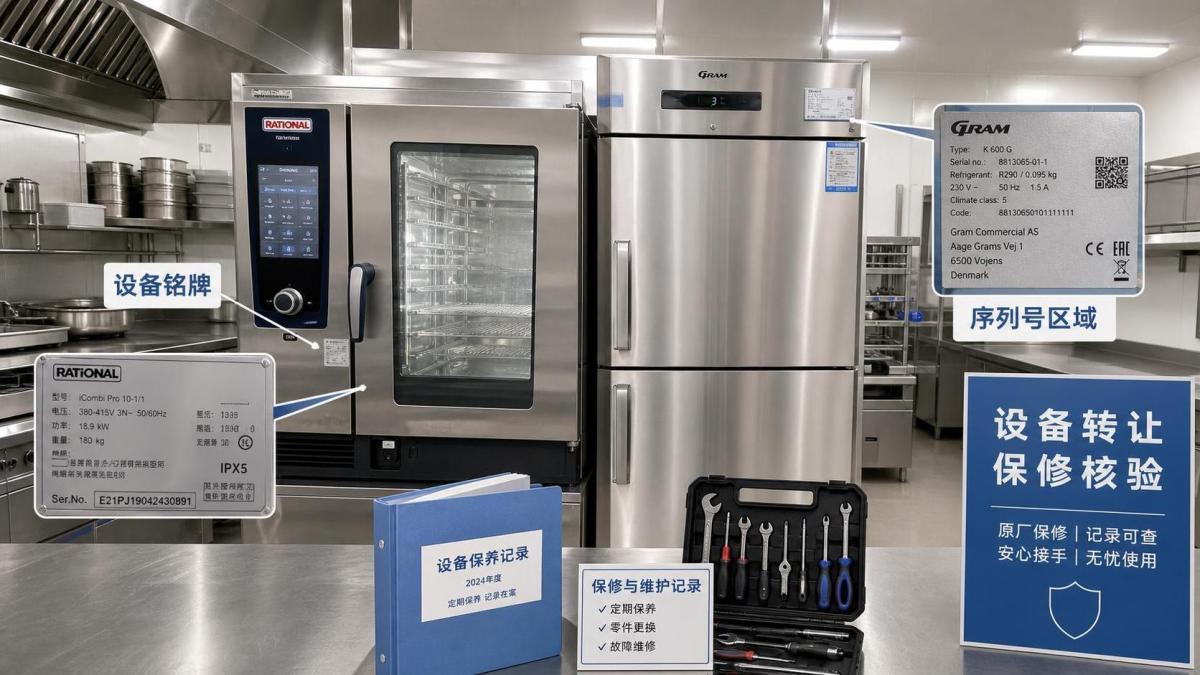
Before funds are released, the seller should provide clear copies of the rating plate, original invoice, warranty certificate, commissioning sheet, repair invoices, and maintenance logs. These documents should be matched carefully. A serial number on an invoice that differs by one digit from the physical plate can indicate a simple clerical error, but it can also mean the paperwork belongs to another unit.
Relocation is a frequent source of warranty disputes
Moving catering equipment changes more than its address. A heavy oven, blast freezer, food cutter, or refrigeration unit can be damaged by transport vibration, improper lifting, condensation, electrical disconnection, or reassembly errors. Warranties commonly exclude damage caused during removal, shipping, storage, or reinstallation unless the work is carried out under specified conditions.
Installed equipment deserves particular attention. Gas cooking lines, extraction interfaces, water-fed combi ovens, drain connections, remote refrigeration systems, and hard-wired induction appliances depend on site conditions. If a unit is removed from an approved installation and later connected to a different supply, the original warranty may no longer apply even if the equipment itself is within the stated time period.
Electrical requirements are often misunderstood. A control panel may power up on a new site while the supply is still unsuitable because of voltage variation, phase configuration, neutral connection, circuit protection, or earthing quality. Failure caused by an incorrect supply is normally excluded. Similar issues arise when a refrigeration cabinet is placed in a hot, poorly ventilated enclosure or when a combi oven receives untreated water that causes rapid scale accumulation. The warranty question then becomes one of installation and operating condition, not merely transfer of ownership.
Territory and import status can limit coverage
Warranty obligations are often administered through regional distributors. Equipment bought in one country and relocated to another may have no local warranty service, even where the factory warranty period has not expired. Parallel imports can create a similar problem. The appliance may be genuine, yet the local service network may not be required to honor coverage attached to a different sales territory.
This is especially relevant to electrical cooking equipment and refrigeration systems because parts availability, electrical configuration, refrigerant specification, and technical documentation can vary across markets. Confirm that the serial number is recognized in the country where the equipment will operate. A verbal assurance that “parts are available” does not answer whether labor and warranty authorization are available.
Condition clauses matter as much as ownership clauses
A transferable warranty does not erase the conditions that applied to the original unit. Commercial kitchen equipment is expected to receive routine cleaning and maintenance. A claim can fail when evidence points to neglected condenser cleaning, blocked air paths, limescale, worn seals left unattended, overloaded motors, damaged power cables, or cleaning chemicals that attacked non-compatible surfaces.
Some signs of neglect are less obvious. A refrigeration unit that runs continuously may be suffering from dirty condenser fins, a failed fan, poor door closure, or excessive ambient heat. These causes have different repair paths, but all can affect a warranty claim if the maintenance record is absent. An ice buildup issue may stem from a door being left open, a damaged gasket, a drainage fault, or a defrost control defect. The visible symptom is not enough to establish covered failure.
Alterations are another boundary. Drilling cabinet panels for a custom pass-through, replacing the supplied plug, fitting non-approved controllers, modifying a gas train, changing fan wiring, or adapting a machine for a different product can void coverage on the affected system. Even a practical modification intended to suit a kitchen layout can create uncertainty about causation. Keep records of every alteration and obtain written approval where warranty coverage remains important.
Distinguish a transferable warranty from a seller guarantee
Used-equipment transactions often include a short assurance from the reseller or previous owner. That promise can be valuable, but it is not the same as an original manufacturer warranty. The party making the promise determines who pays for labor, replacement parts, collection, transport, and downtime-related logistics. It may also impose its own inspection period or require the equipment to remain at the original delivery location.
A transfer document should identify the exact machine by model and serial number, state the original warranty expiration date, name the coverage being transferred, and confirm whether approval has been granted. It should also state whether a new registration, inspection, or service visit is required. General phrases such as “all warranties pass to purchaser” are weak when the manufacturer terms say otherwise.
There is a useful difference between a warranty assignment and proof that a claim will be accepted. Assignment describes a change in contractual rights. Claim acceptance still depends on diagnosis, documentation, exclusions, and compliance with service procedures. A warranty administrator may accept the transfer while declining a later claim because the fault resulted from transport damage or unsuitable installation.
A practical verification sequence before purchase
- Photograph the complete rating plate, including the serial number, electrical data, refrigerant information where applicable, and production code. Do not rely on a typed serial number in an online listing.
- Request the original invoice and read the warranty terms that applied when the equipment was sold. Newer web terms are not necessarily the terms governing an older machine.
- Contact the warranty administrator or authorized service channel with the serial number. Ask whether coverage remains, whether it transfers, what parts are covered, and what written transfer action is required.
- Establish the unit’s history: original installation date, previous location, repairs, component replacements, water treatment arrangements, cleaning routine, and any modifications.
- Review the destination site before moving the machine. Confirm power, water, drainage, ventilation, clearance, floor loading, extraction connections, and access for future service.
- Put the transfer outcome in the transaction documents. Include any deadline for registration and identify which party will complete it.
The contact with the warranty administrator should be specific. “Is this unit under warranty?” invites a broad answer. A better request identifies the serial number, current owner, destination address, proposed installation date, and the type of coverage being verified. Written confirmation is preferable because call-center guidance can be incomplete and may not form part of the warranty record.
Equipment category changes the risk behind the answer
For a stainless steel worktable or storage cabinet, warranty transfer may have limited financial significance unless structural defects, corrosion claims, or fabrication faults are involved. The condition of welds, seams, legs, castors, and load-bearing shelves is usually more important than a short remaining warranty period.
For refrigeration, blast freezing, and ice-related equipment, remaining coverage can be more material because sealed-system work, leak diagnosis, compressor replacement, evacuation, and recommissioning require specialist labor. Yet that is also where relocation, ventilation, ambient temperature, and maintenance records receive closer scrutiny.
Cooking equipment has a different pattern. Heating elements, relays, boards, probes, induction coils, fans, steam-generation components, and door mechanisms may have separate exclusions. A combi oven with a recent descale history and documented water treatment presents a different warranty position from one with heavy mineral deposits and intermittent fault codes, even if both have the same model number.
Machinery with moving blades, belts, bearings, safety interlocks, and motors requires careful distinction between a manufacturing defect and wear from production use. Consumables and wear items are often excluded. A transfer does not turn a worn cutting assembly or aged seal into a covered defect.
The reliable answer to whether commercial catering equipment warranties are transferable is therefore conditional but actionable: verify the original written terms, confirm the serial number with the party that administers coverage, document ownership and installation history, and treat transport and recommissioning as potential warranty events. A used machine should be valued on its confirmed coverage and demonstrable condition, not on an unverified claim that a warranty remains.
Search News
Popular Tags
Reserve Your Copy
COMPLIMENTARY INSTITUTIONAL ACCESS
Trusted by procurement leaders at
Get weekly intelligence in your inbox.
No noise. No sponsored content. Pure intelligence.
Recommended News