Sunflower Oil Storage Tanks: Heating, Cleaning, and Safety Checks
Sunflower oil storage tanks are often discussed as simple holding vessels, but in a food processing plant they influence product quality, production continuity, cleaning workload, and downstream filling performance. A tank that is easy to fill but hard to clean can slow the plant. A tank that holds temperature poorly can make transfer inconsistent. A tank that lacks clear safety and drainage planning can create daily operator friction. For buyers evaluating oil storage, the tank should be reviewed as part of the processing and automation workflow, not as an isolated container.
Sunflower oil has handling characteristics that make practical design review important. It is a food product, so sanitary construction matters. It may be stored before filtration, blending, packaging, or bulk shipment. It can be sensitive to oxygen, moisture, residues, and excessive heat. The storage tank should therefore support controlled holding, predictable discharge, repeatable cleaning, and safe operation for the people who run the line.
This article gives buyers a checklist for heating, cleaning, safety, and process fit when selecting sunflower oil storage tanks. It focuses on practical decisions: material, internal finish, bottom design, heating method, insulation, drainage, nitrogen protection, cleaning access, automation signals, and installation details. These are the points that usually decide whether a tank performs well after commissioning.
Why Sunflower Oil Storage Needs Process-Level Thinking
Storage is not a pause in the production process. It is a controlled step between receiving, processing, blending, filtration, and filling. If the storage step is unstable, the rest of the line can be affected. Product may not discharge at the expected rate, operators may spend more time cleaning, and downstream filling equipment may wait for a consistent feed.
For food processors, tank selection should begin with real operating conditions. Buyers should define the expected oil temperature, viscosity behavior, holding time, turnover frequency, batch size, filling rate, and cleaning procedure. A tank used for short buffer storage before packaging can be different from a tank used for longer holding or bulk transfer.
Automation also changes the discussion. If the tank is integrated into an automated process, level measurement, temperature control, pump interlocks, alarms, and valve feedback may be needed. Even when the tank itself is simple, the plant may need reliable signals so operators can manage filling, heating, transfer, and cleaning without constant manual checking.
Material, Finish, and Food-Contact Construction
Stainless steel is commonly selected for food oil tanks because it supports hygienic handling and long service life. Buyers should still confirm the exact material grade, product-contact finish, welding treatment, gasket compatibility, and fitting design. A tank can be made from stainless steel and still have details that make residue removal or inspection harder than necessary.
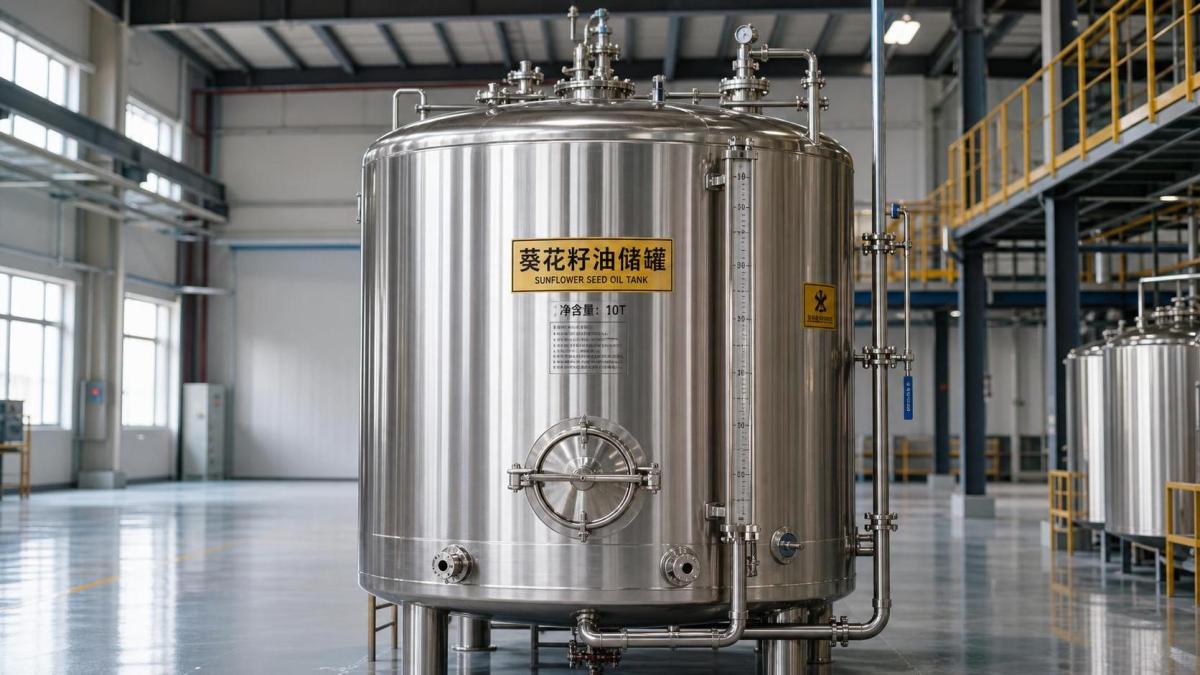
Internal surfaces should be suitable for food-contact cleaning. Welds and corners should avoid unnecessary traps. Manways, vents, inlets, outlets, sampling ports, temperature sensors, and level instruments should be placed for both process function and operator access. A beautiful outside shell is not enough if the inside is difficult to inspect or drain.
Buyers should also ask about seals and gaskets. The materials should be compatible with sunflower oil, cleaning media, operating temperature, and expected service intervals. Small components can create large problems when they swell, crack, or trap residue.
Heating and Insulation Checks
Sunflower oil often remains workable at normal plant temperatures, but heating may still be needed in some facilities, climates, or processing steps. Heating can help maintain flow, support transfer, prepare product for downstream processing, or support cleaning. The key is controlled heating, not simply adding more heat.
Buyers should confirm the target storage temperature, required discharge temperature, acceptable warm-up time, and maximum temperature limits for the product. Heating may be provided by a jacket, coil, external circulation, or another method. The selection should be based on product behavior, heating medium, cleaning requirements, and the plant's available utilities.
Insulation can reduce heat loss and improve stability. It may also protect operators from hot surfaces, depending on the design. Temperature sensors should be located where they provide useful process information. If the sensor is in a poor position, the control system may show a temperature that does not represent the real tank condition.
Cleaning and Drainage Discipline
Cleaning is one of the most important practical checks for edible oil tanks. Oil residue can be stubborn, especially if the tank has poor drainage or hidden low points. Buyers should clarify whether the tank is cleaned manually, through a spray device, through CIP connections, or through a plant-specific combination of methods.
Drainage design should support complete discharge of product and cleaning liquid. Bottom slope, outlet location, valve placement, pump connection, and pipe routing all influence how much material remains after transfer. If operators must spend extra time clearing residue, the tank becomes a recurring labor issue.
Cleaning access should also be safe. Manways, platforms, ladders, guardrails, and access points should be planned before installation. If internal inspection is part of the sanitation program, confined-space safety and plant procedures must be respected. Tank design should support those procedures rather than force operators into improvised workarounds.
Oxidation Control and Headspace Management
Oxygen exposure can affect edible oils depending on product type, storage time, temperature, and headspace conditions. Some plants use nitrogen blanketing to reduce oxygen contact in the tank. Others rely on short holding times, careful transfer, and controlled packaging. The correct approach depends on the plant's quality plan.
If nitrogen protection is required, the tank should include suitable connections, venting, pressure control, and operator instructions. Blanketing should not be treated as a vague option. Buyers need to know what is included, what nitrogen source is required, how pressure is controlled, and how the system behaves during filling and discharge.
For an edible oil storage tank, headspace management should be reviewed alongside material, heating, cleaning, and drainage. Product protection is strongest when these design choices support one another.
Safety and Automation Checks
A storage tank should be safe and practical for operators. Safety checks include access, pressure and venting, hot surfaces, moving equipment around the tank, drainage paths, and emergency procedures. If the tank includes heating, agitation, nitrogen, or automated valves, the controls should be easy for operators to understand.
Automation can reduce manual checking when it is designed carefully. Useful automation signals may include level, high-level alarm, low-level alarm, temperature, valve status, pump interlock, and cleaning-cycle status. The plant does not need unnecessary complexity, but it does need enough information to prevent overfilling, dry pump operation, temperature drift, or cleaning mistakes.
Documentation should support operation. Buyers should request drawings, connection lists, utility requirements, control descriptions, spare-part lists, and maintenance guidance. These documents help operators and maintenance teams understand the tank after it is installed.
Buyer Checklist for Sunflower Oil Storage Tanks
Installation and Layout Planning
Installation planning should begin before the order is finalized. Buyers should confirm footprint, height, foundation, access, pipe routing, pump location, drainage, and maintenance clearance. If the tank is installed near a filling line, the discharge route and line rhythm should be reviewed together.
Utilities also need attention. Heating may require steam, hot water, thermal oil, or electricity. Cleaning may require hot water, detergent, sanitizer, compressed air, and drain capacity. Automation may require control wiring and signals. Nitrogen protection requires a suitable supply and safe pressure control. Each utility should be confirmed before shipment.
If the plant expects future expansion, the layout should allow practical access for additional tanks, transfer lines, filtration units, or filling equipment. A tank selected for today's volume should not block tomorrow's workflow.
Common Mistakes to Avoid
One common mistake is choosing capacity without defining the real production rhythm. Another is ignoring cleaning until after installation. A third is adding heating without defining the temperature target or sensor placement. These issues may seem small during procurement, but they can affect daily operation.
Buyers should also avoid vague automation. A quotation that says "level control included" should explain what instrument is used, what signal is provided, and how alarms or interlocks work. Clear scope helps both buyer and supplier avoid misunderstandings.
Finally, do not treat sunflower oil storage as only a tank purchase. It is part of a food processing system that includes receiving, heating, filtration, transfer, cleaning, and packaging. The best tank design supports the full process.
FAQ
What should buyers check first when comparing sunflower oil storage tanks?
Start with product handling conditions: temperature, holding time, turnover rate, discharge needs, and downstream process. These factors shape the tank design.
Does oil storage always require heating?
No. Heating depends on oil behavior, climate, discharge temperature, process target, and cleaning method. Buyers should define the need before selecting a heating configuration.
When is nitrogen blanketing useful?
Nitrogen blanketing may be useful when oxygen exposure is a quality concern, especially with longer storage time or sensitive products. It should be designed with venting and pressure control.
How can automation help oil storage?
Automation can help monitor level, temperature, alarms, valve status, and pump interlocks. It should make operation clearer without adding unnecessary complexity.
Editorial Review Note
This article is buyer-facing guidance for sunflower oil storage tank selection in food processing automation contexts. It avoids fabricated prices, unsupported performance statistics, invented case numbers, and unverified certification claims. Final upload should be checked against the destination portal's house style and formatting rules.
Search News
Popular Tags
Reserve Your Copy
COMPLIMENTARY INSTITUTIONAL ACCESS
Trusted by procurement leaders at
Get weekly intelligence in your inbox.
No noise. No sponsored content. Pure intelligence.
Recommended News