Countertop Convection Ovens vs Deck Ovens for Fast Baking
Fast baking depends on more than temperature alone. In busy foodservice settings, the choice between countertop convection ovens and deck ovens shapes output speed, bake consistency, labor rhythm, and how well limited space supports daily production.
That decision matters across cafés, snack counters, hotel breakfast stations, bakery corners, and compact central kitchen lines. When volume is rising but floor area is tight, oven format becomes an operational question, not just an equipment preference.
From the CKFS perspective, this comparison also connects with hygiene design, thermal control, energy use, workflow efficiency, and ROI per square foot. In other words, oven selection affects the whole production system around the bake.
What separates these two oven types
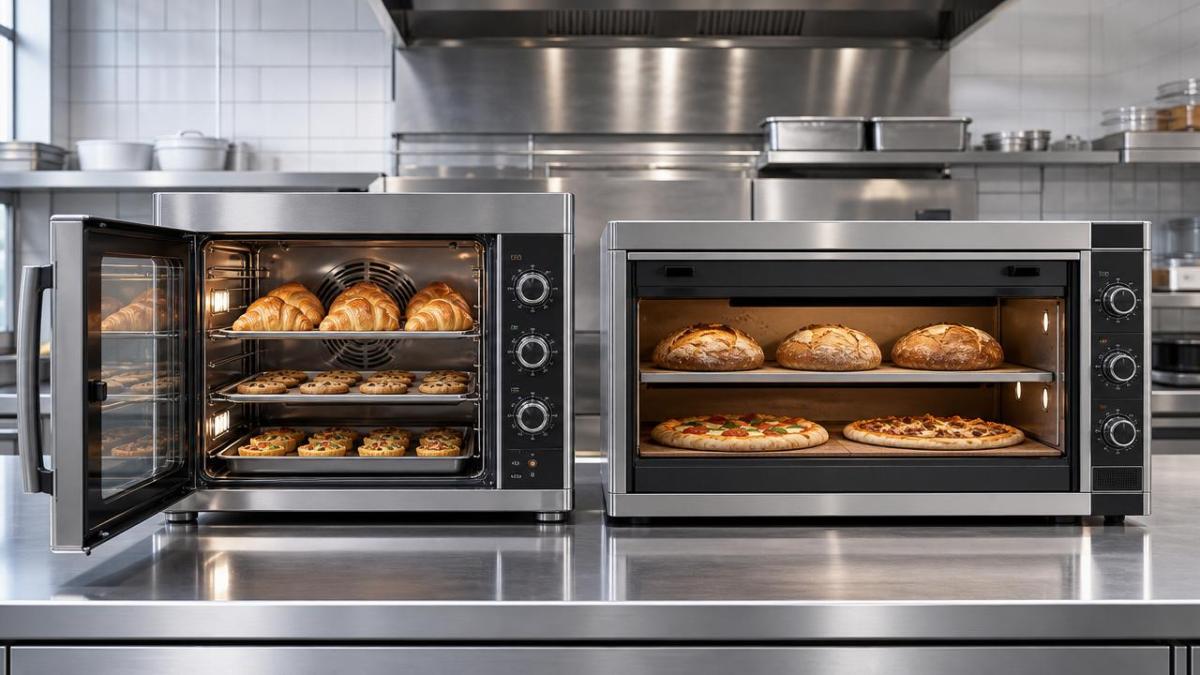
The image helps frame the core difference in chamber design and airflow.
Countertop convection ovens use forced hot air. Fans move heat around the cavity, helping products bake faster and more evenly than in still-air designs.
Deck ovens rely on radiant and conductive heat. Products sit on stone, steel, or deck surfaces, and the chamber usually has less aggressive airflow.
For fast baking, that difference is decisive. Countertop convection ovens often recover heat quickly after door opening and shorten bake time for light pastries, cookies, reheated bakery items, and small-batch savory products.
Deck ovens are valued for crust development, bottom heat, and artisan texture. They are less about speed alone and more about baking character, especially where dough structure and finish matter.
Why the comparison matters now
Foodservice operations increasingly need flexible output. Menus change faster, labor is tighter, and smaller footprints must deliver more revenue from each workstation.
That is why countertop convection ovens are getting more attention. They fit sites where speed, multi-product handling, and installation simplicity carry more weight than traditional bakery theater.
At the same time, deck ovens remain relevant where signature bread, pizza, flatbreads, or premium pastry texture define product value. The industry focus is not about one oven replacing the other.
It is about matching thermal behavior to business reality. CKFS regularly frames this kind of decision through standardization, cleaning practicality, compliance readiness, and long-term operating efficiency.
Speed is only one part of fast baking
In actual use, “fast” can mean several things. It may mean shorter preheat, quicker bake cycles, faster recovery between batches, or less waiting during service peaks.
Countertop convection ovens usually perform well in all four areas. Their compact chambers heat rapidly, and forced airflow supports repeatability when batches are frequent and varied.
Deck ovens may take longer to preheat, especially with stone decks. However, once stabilized, they can produce highly consistent results for the same product over longer runs.
So the real question is not simply which oven is faster. It is whether the operation needs fast switching or stable repetition.
A practical comparison at a glance
Product quality depends on the product itself
A common mistake is judging ovens in the abstract. Performance changes with cookies, croissants, par-baked bread, pizza slices, buns, quiches, or filled snacks.
Countertop convection ovens usually shine with products that benefit from circulating heat. Think laminated pastries needing even color, frozen bakery items needing fast regeneration, or snacks requiring quick turnover.
Deck ovens often excel when bottom heat and moisture retention help shape the final bite. Rustic bread, open crumb loaves, pizza crust, and some hearth-style pastries can benefit from that environment.
This means quality is not a fixed advantage of one oven type. It is a match between thermal method and product goal.
Where countertop convection ovens are strongest
- Rapid baking of small pastries, cookies, and ready-to-bake items.
- Fast menu changeovers during breakfast, lunch, and evening peaks.
- Sites where ventilation planning and floor space are limited.
- Operations needing easy operator training and repeatable timing.
- Back-of-house setups where countertop workflow improves reach and staging.
Workflow, cleaning, and space use often decide the winner
In many kitchens, the oven that fits the workflow best creates more value than the oven with the strongest baking tradition.
Countertop convection ovens support short movement paths. Trays, proofed items, frozen products, and finishing tools can stay within one compact station.
That can reduce wasted steps and improve service speed. It also helps when labor experience varies and the process needs visual simplicity.
Deck ovens ask for more deliberate loading, unloading, and floor allocation. That is not a disadvantage by itself, but it changes staffing rhythm and layout planning.
Cleaning deserves equal attention. Smooth interior surfaces, removable racks, door sealing quality, crumb handling, and access around the oven all influence hygiene performance and downtime.
From a CKFS systems view, the best baking line is not only productive. It is cleanable, safe, and easy to keep standardized under daily pressure.
Energy use and consistency are part of the business case
Energy cost is not just about rated power. It also depends on idle time, preheat losses, door opening frequency, and how much product value each cycle generates.
Countertop convection ovens often work efficiently for short, frequent batches. They can avoid the burden of heating a larger mass when demand is uneven throughout the day.
Deck ovens may justify their energy profile when production is steady and premium bake characteristics support higher selling value or lower product rejection.
Consistency matters just as much. Fast baking loses value if results drift across trays, shifts, or operators. Reliable controls, airflow balance, and thermal recovery should be checked before focusing on headline capacity.
Questions worth checking before selection
- How many different products need to be baked within one hour?
- Is the goal quick finishing, full baking, or reheating with color?
- How often will the door open during peak periods?
- Is floor space more limited than electrical capacity?
- Does product value depend on artisan crust or on service speed?
- How easy is the oven to clean between shifts and product changes?
How to make the decision in real operations
If the menu leans toward rapid turnover, compact installation, and broad product variety, countertop convection ovens are often the practical choice.
If the menu depends on crust identity, hearth effect, or dedicated dough quality, a deck oven may better support the final product even with slower cycle preparation.
Some operations also benefit from a split setup. A deck oven handles signature items, while countertop convection ovens support finishing, overflow, and faster secondary baking tasks.
That mixed approach often reflects how commercial kitchens actually evolve. Equipment choices become layered around demand patterns, hygiene rules, and labor realities.
The next step is to compare actual products, batch timing, cleaning routines, and space constraints side by side. Once those factors are clear, the better oven type usually becomes obvious.
Search News
Popular Tags
Reserve Your Copy
COMPLIMENTARY INSTITUTIONAL ACCESS
Trusted by procurement leaders at
Get weekly intelligence in your inbox.
No noise. No sponsored content. Pure intelligence.
Recommended News